Is Montreal’s commercial real estate sector turning the corner?
Like elsewhere, Montreal’s commercial real estate market continues to adapt to various challenges. Yet after several difficult years, including a pandemic, the most rapid interest rate hiking cycle in modern times, and a trade war with the U.S., the city’s real estate markets appear to be finding its footing. Could brighter days be ahead?
The city’s capital markets show a marked improvement in sales volumes. Office, retail and apartment sales are well above recent historic quarterly averages. Only industrial sales lag, likely as concerns about the uncertain U.S.-Canada trade policy continue to linger, coupled with concerns surrounding a potential overhang of new supply. Yet with the Canada-U.S.-Mexico Agreement, or CUSMA, set to be discussed next year, there is hope that a trade deal can eventually be reached.
At the same time, future supply pipelines for office and industrial remain extremely limited. No major office projects are under construction, and new industrial construction as a percentage of existing inventory is now just 1%, less than 1.5% nationally.
On the demand side, it remains a tenant-friendly environment for office occupiers. Yet potential demand for newer, more modern space should ensure that buildings built in 2010 and later will continue to see availability rates decline and occupancy improve.
According to market participants, the ongoing effects of the U.S.-Canada trade war continue to weigh on industrial occupier sentiment. However, assuming that a new trade deal is reached, industrial occupiers should start to feel more certain about taking new space in the future. And even with this uncertainty, leasing volumes are still up compared to 2024.
Despite lingering weaknesses, such as an overhang of large-bay recently delivered industrial buildings and the ongoing adoption of hybrid work models by some office occupiers, a general upward trend in leasing for both office and industrial space is evident in recent quarters.
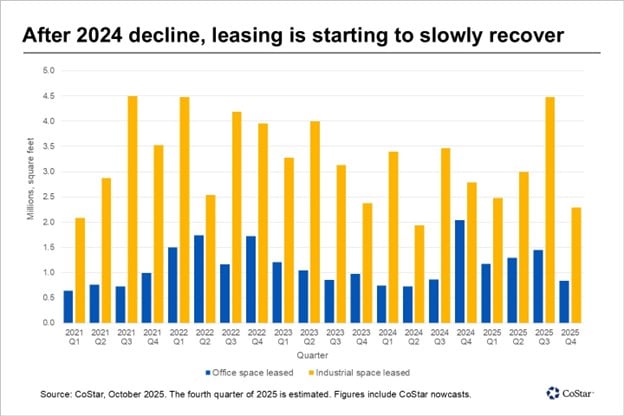
Some of this increased leasing activity is no doubt driven by occupiers who can negotiate rents below advertised rates. Still, the increase in leasing is an encouraging sign that space markets may be finding their footing again.
In addition, Montreal is set to elect a new mayor and a new administration, which could change how the city addresses its real estate development challenges, especially the issue of developing housing units. Ensemble Montréal, the party leading in the polls at the time of this writing, would reverse some of the former administration’s policies and instead focus on working with the private sector to develop housing, speed up permitting, and accelerate development of available sites like the Hippodrome, according to the party’s website.
The lack of new office and industrial building intentions should help support a recovery in the leasing markets, especially as space demand picks up as well. The increase in transaction volumes is perhaps another sign that the city’s commercial real estate sector is ready to turn a corner. At the same time, a new city administration could speed permitting processes and thus spur needed development for housing units. While far from certain, 2026 appears to have the ingredients to be a year of recovery for Montreal’s real estate sector.